
Partition stories are supposed to leave a lump in your throat. They remind us of homes abandoned, families separated and memories that refuse to fade. Imtiaz Ali's Main Vaapas Aaunga wants to be all of that and more. It wants to be a love story, a family drama, a meditation on memory, and a conversation between generations. The intentions are noble. The execution, unfortunately, is far less impressive.
By the time the film reaches its destination, you may find yourself feeling exactly like one of its characters who says, "Ghoom ghoom ke jana padta hai, bahot waqt lagta hai." That line unintentionally sums up the entire experience.
Mai Vaapas Aaunga Review
Director: Imtiaz Ali
Cast: Diljit Dosanjh, Naseeruddin Shah, Vedang Raina, Sharvari, Banita Sandhu, Rajat Kapoor, Anjana Sukhani, Manish Chaudhari, Jaipreet Singh
Where To Watch: In Theatres
Runtime: 166 minutes
Rating: 2/5 stars
1. Plot Details
The story follows Nirvair (Diljit Dosanjh), a London-based man who feels disconnected from almost everything in his life. His job doesn't excite him, his stand-up comedy career isn't taking off, and even his relationship seems uncertain.
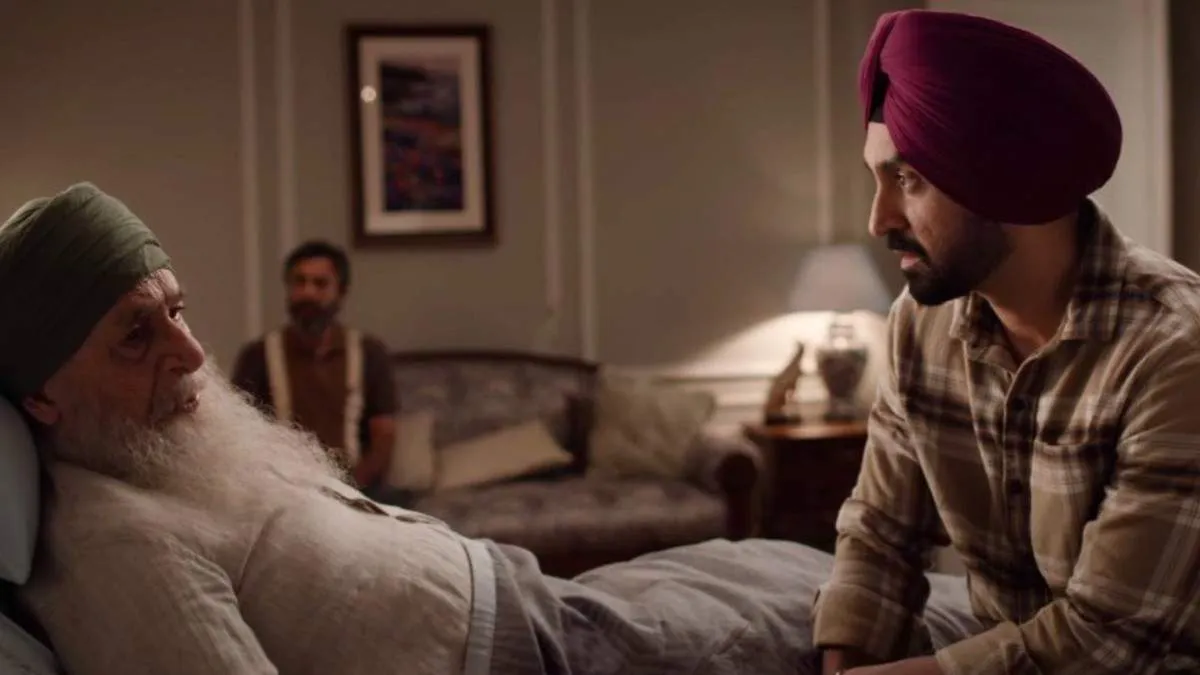
Back in India, his ageing grandfather Ishar Singh, lovingly called Keenu (Naseeruddin Shah), is battling dementia. As Keenu drifts between reality and memory, he keeps speaking about strange things that make little sense to his family.
Trying to understand his grandfather's fragmented thoughts, Nirvair begins tracing a story buried deep in the past. That search takes him to pre-Partition Punjab, where a young Ishar (Vedang Raina) falls in love with Afsana (Sharvari), a woman from a different faith.
As Partition approaches and tensions rise, their romance becomes entangled with one of history's most painful chapters.
The setup is intriguing. A grandson decoding memories to uncover a lost love story sounds like classic Imtiaz Ali territory. Sadly, what begins with promise slowly gets lost in its own maze.
2. Script Analysis
On paper, the story sounds rich. Love, memory, Partition, identity and belonging are all powerful themes. But the screenplay never finds a smooth way to bring them together.
The film constantly jumps between timelines, flashbacks and emotional detours. While this fractured structure seems designed to reflect Keenu's mental state, it often creates confusion rather than emotional depth.
The biggest problem is pacing. At nearly 166 minutes, the film feels exhausting. Scenes stretch well beyond their natural endpoint. Conversations repeat ideas we already understand. Emotional moments linger so long that they begin losing their impact.
Imtiaz Ali's best films usually make us discover emotions alongside the characters. Here, the film keeps explaining those emotions to us again and again.
The love story is another weak spot. We are told that Ishar and Afsana share a once-in-a-lifetime romance, but we rarely feel it. Their relationship remains more poetic in theory than moving in practice.
The film also simplifies several complex aspects of Partition history. Its treatment of communal violence occasionally feels one-sided and lacks the nuance such a sensitive subject demands. The result is a story with important ideas but surprisingly little emotional payoff.
3. Performances & Execution
If there's one reason to watch this film, it is Naseeruddin Shah. The veteran actor delivers a masterclass in portraying dementia. Confined largely to a bed, he communicates confusion, longing and heartbreak through trembling hands, broken sentences and expressive eyes. Every scene featuring Shah feels alive.
Vedang Raina is sincere as the younger Ishar. He captures the character's innocence and optimism well. Sharvari also delivers a restrained and graceful performance, though the script doesn't give her enough material to fully shine.
Diljit Dosanjh is the film's biggest missed opportunity. He is a naturally charismatic performer, yet the screenplay reduces him to an observer for most of the runtime. Instead of driving the story, Nirvair spends much of the film reacting to events.
The supporting cast, including Rajat Kapoor, Banita Sandhu, Anjana Sukhani and Manish Chaudhary, do their jobs competently but leave little lasting impact.
As a director, Imtiaz Ali appears unusually restrained. The emotional magic, spontaneity and insight that define his best work are mostly absent here.
4. What Works & What Doesn't
What Works
- Naseeruddin Shah's heartbreaking performance
- Beautiful visuals throughout the film
- Some genuinely moving ideas about memory and displacement
- AR Rahman's music adds emotional texture
- The final portions and end-credit song leave a stronger impression than the rest of the film
What Doesn't
- Overlong runtime
- Weak pacing
- An underwhelming central romance
- Diljit Dosanjh feels underutilised
- Too many unnecessary subplots
- Emotional scenes become repetitive
- Simplistic handling of some Partition politics
- More ambition than actual storytelling
5. Technical Aspects
Visually, the film is often stunning. The cinematography captures pre-Partition Punjab with warmth and nostalgia. Several frames look like old photographs brought to life. The use of light and shadow effectively reflects the characters' emotional states.
AR Rahman's score frequently does the heavy lifting. The music creates the emotional atmosphere the screenplay sometimes fails to generate. However, surprisingly few songs remain memorable after the film ends. The sound design is effective without drawing attention to itself.
Editing, unfortunately, is where the film suffers. A tighter cut could have significantly improved the experience. The narrative often feels bloated and repetitive.
Production design deserves praise for recreating different time periods with authenticity and detail.
6. Final Thoughts
Main Vaapas Aaunga wants to explore memory, love, identity and the lingering wounds of Partition. Those are fascinating themes. Unfortunately, the film spends so much time wandering through its ideas that it forgets to tell a compelling story. There is sincerity here. There is beauty too. But there is also a frustrating lack of focus.
For a filmmaker known for creating unforgettable emotional journeys, this feels surprisingly distant and uneven.
7. Should You Watch It?
Depends.
If you're a hardcore Imtiaz Ali fan, you may appreciate the film's themes and occasional flashes of brilliance. Fans of Naseeruddin Shah will certainly find plenty to admire.
However, casual viewers looking for an engaging Partition drama or a memorable romance may struggle with its slow pace and uneven storytelling.
Watch it for Naseeruddin Shah. Stay only if you're willing to be patient.