


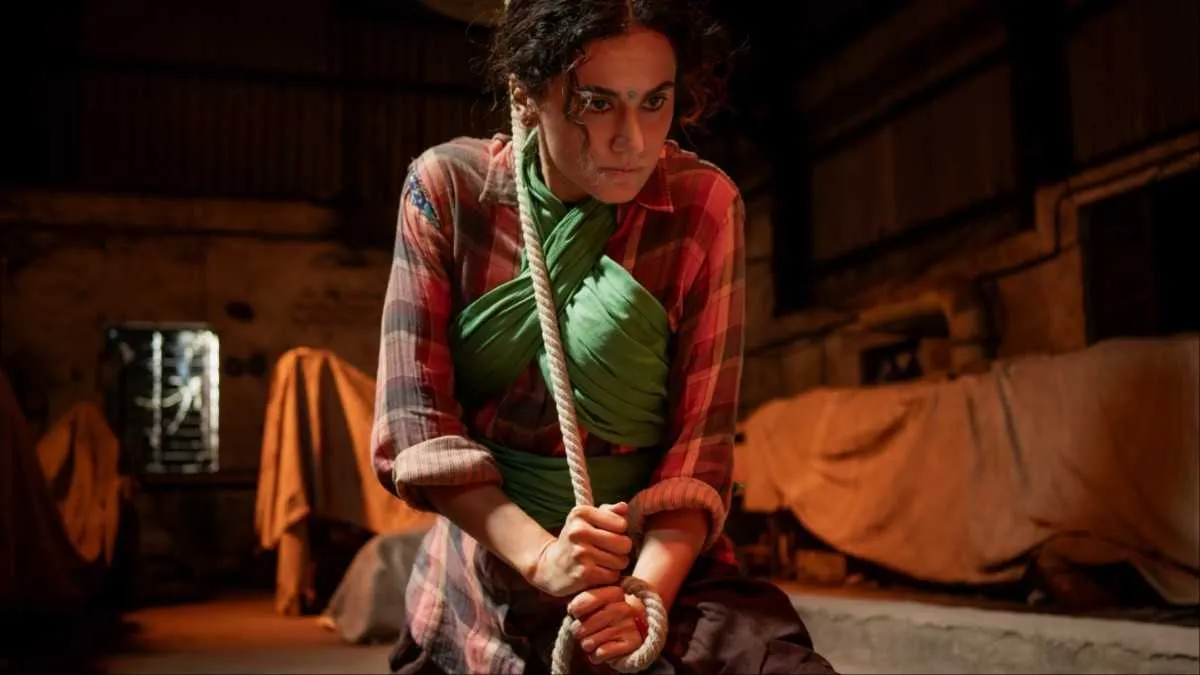
Gandhari puts a mother at the center of a revenge story that gets darker with every turn. Taapsee Pannu gives the role plenty of force, but the film keeps taking its story in unexpected directions. Some choices work, while others leave you wondering what the film is trying to pull off. Read our Gandhari review to see whether it all comes together.
Gandhari Review
Director: Devashish Makhija
Cast: Taapsee Pannu, Ishwak Singh, Mita Vashisht, Swastika Mukherjee, Chhaya Kadam, Jatin Sarna, Prashant Narayanan, Chandan Roy, Vishwanath Chatterjee, Priti Shroff
Where To Watch: Netflix
Runtime: 1 hour 15 minutes
Rating: 2/5 Stars
1. Plot Details
Gandhari follows Bani, a mother whose daughter Mishty is kidnapped while the family is passing through Joypurra. Bani chases the kidnapper and gets badly injured, leaving her temporarily blind.
She and her husband Gokul turn to the local police for help. However, the authorities do not treat the case with the urgency it demands. The situation changes when Kabir, an officer from the Anti-Human Trafficking Unit, arrives to investigate the growing number of missing girls.
Bani, meanwhile, refuses to sit around and wait. She starts looking for her daughter herself and discovers that Joypurra is hiding more than one ugly secret. Her connection with Jhunu Amba also pushes her toward a more dangerous path.
That setup gives Gandhari a clear engine. A mother has lost her child, the system is failing her, and she decides to fight back. The trouble starts when the plot adds more layers without always explaining them well.
The missing girls, Bani's past and several characters become increasingly difficult to piece together. Some twists add intrigue, while others feel like the screenplay is asking for a free pass.
2. Script Analysis
The basic story is familiar. Bollywood has already given us several mothers who cross every line to protect their children. Gandhari tries to give the formula a different shape through Bani’s blindness and the strange world of Joypurra.
One of the film’s better ideas is the blindness track. It does not simply turn Bani into a helpless character. Instead, her condition becomes part of the way she deals with the danger around her.
Another interesting touch is the fictional town. Joypurra, its Bahrupi community, and the Chaumukhi festival give the movie an identity of its own. These details make the setting feel lived-in rather than like a generic thriller location.
However, the screenplay cannot maintain that same level of confidence throughout. Bani learns things remarkably quickly, while some characters appear just when the plot needs them. The kidnapping and missing-girls storyline also becomes muddled.
A bigger issue is the emotional writing. The film wants Bani’s relationship with her daughter to carry the entire story, yet it does not spend enough time making that bond feel natural. As a result, the emotional beats are often stated instead of earned.
Things get worse in the third act. The climax stretches the story when it should be tightening the screws. Some developments involving Bani and Gokul also feel unnecessary and difficult to accept.
3. Performances & Execution
Taapsee Pannu does most of the heavy lifting. She looks convincing during the action scenes and handles Bani's physical struggle with confidence. Her emotional work also has good moments, even when the writing does not give her enough material to build on.
Ishwak Singh is sincere as Gokul, but his character is not written strongly enough. The same problem affects several supporting roles.
Jatin Sarna makes an impression as Kabir. His arrival gives the investigation some much-needed energy. Mita Vashisht gets a more forceful role as Jhunu Amba and makes the most of it.
Chhaya Kadam is effective as Uma, though the film could have used more of her. Chandan Roy also leaves an impression despite limited screen time.
Prashant Narayanan plays the antagonist, but the character arrives too late to create the level of menace the story needs. Swastika Mukherjee, Priti Shroff and Vishwanath Chatterjee also add to the ensemble.
Director Devashish Makhija keeps the film moving and gives the action scenes enough bite. Since Gandhari runs for under two hours, it rarely gets bogged down for long. Still, faster pacing cannot hide weak character logic.
4. What Works & What Doesn’t
What works
- The film becomes a little engaging once Bani starts taking control.
- The action sequences add energy without becoming excessively gory.
- The setting gives the thriller an unusual atmosphere.
- Several supporting performances add weight to key moments.
What Doesn't
- Several plot developments rely too heavily on coincidence.
- Some supporting characters enter the story too abruptly.
- The forgotten-past angle creates more questions than satisfying answers.
- Parts of the climax feel stretched and unconvincing.
- The villain does not get enough time to become genuinely threatening.
- The music sometimes tells us exactly what the scene wants us to feel.
5. Technical Aspects
Amit Roy's cinematography does a decent job of capturing Joypurra. The town feels rough, lived-in and distinct from the usual thriller settings. That atmosphere helps the film more than flashy visuals would have.
The production design by Nikhil Kovale and Apurva Bhagat is another strong point. Joypurra looks convincing enough to make its fictional nature easy to forget.
The action choreography by Brahim Achhabake, Riyaz Shaikh, Habib Sayed and Anis Shaikh is exciting. The sequences have impact without turning unnecessarily gory. A few set pieces could have used more intensity, but they still work.
Shor Police's background score supports the action well. The songs are less memorable. At times, the lyrics underline emotions that the scene could have communicated on its own.
Naman Arora's editing is mostly effective, although some cuts feel overly slick. Overall, the technical work is solid enough to support the story without becoming the main attraction.
6. Final Thoughts
Gandhari has the bones of a gripping revenge thriller. It also has a strong lead performance and a setting worth exploring. Taapsee Pannu fights blind with plenty of conviction, but the film cannot quite see its own flaws. Confusing plot turns, convenient writing, and a weak emotional foundation keep it from reaching its potential.
7. Should You Watch It?
If you enjoy revenge thrillers and want to see Taapsee Pannu in another physically demanding role, Gandhari has enough going for it to earn a watch.
If you are looking for a tightly written mystery with a powerful emotional payoff, this one may leave you wanting more. Its short runtime makes it an easy OTT watch, but the uneven writing keeps it from becoming a must-see.