


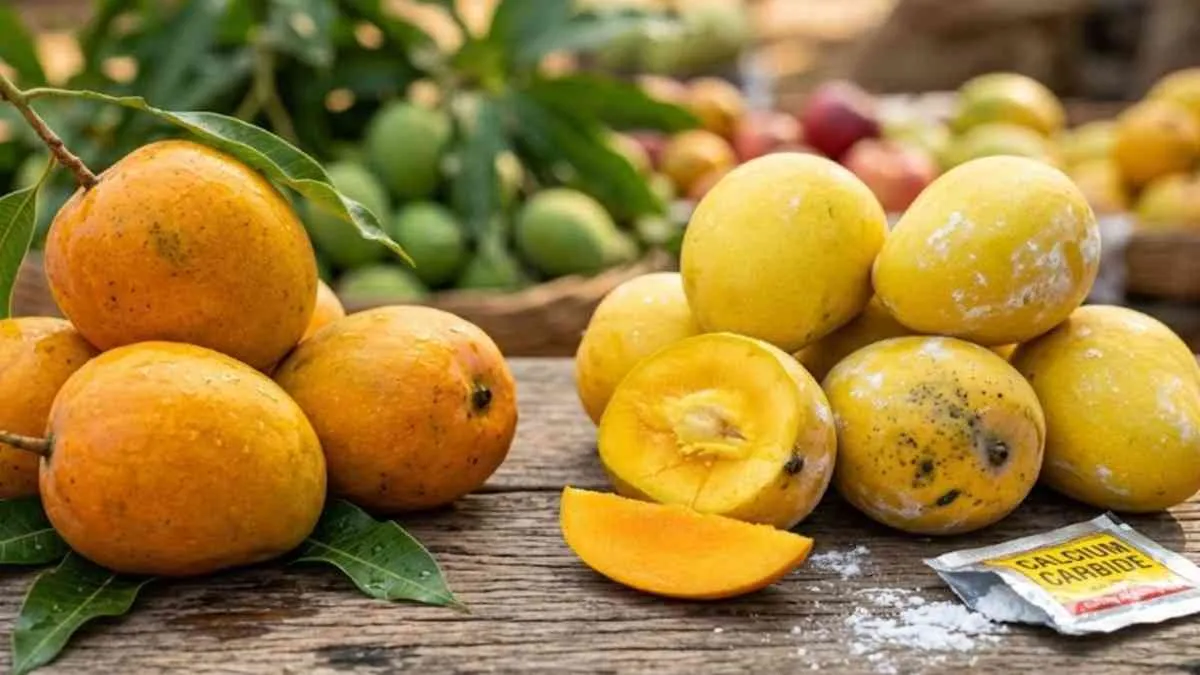
Mango is one of the most loved summer fruits in India. But before you enjoy your next juicy bite, there is one important question to ask - is your mango naturally ripened or artificially ripened using harmful chemicals?
According to AIIMS doctor Priyanka Sehrawat, consumers should be more careful while buying mangoes as some are still ripened using calcium carbide, a banned substance that can pose health risks.
In a recent YouTube video, Dr. Sehrawat explained that while the Food Safety and Standards Authority of India (FSSAI) has banned the use of calcium carbide for ripening fruits, awareness among buyers remains equally important. She shared four simple ways to identify a carbide-ripened mango at home using your own senses.
Mango Safety: Why Carbide-Ripened Fruits Are a Health Concern
A naturally ripened mango is generally safer to eat than one ripened with calcium carbide.
Dr. Priyanka Sehrawat explained that calcium carbide reacts with moisture to produce acetylene gas, which speeds up the ripening process. However, it may also leave behind harmful residues such as arsenic and phosphorus. According to the doctor, these substances can be dangerous for human health if present in food.
This is why the FSSAI has prohibited the use of calcium carbide for ripening fruits. Even so, experts advise consumers to stay alert while shopping, especially during the peak mango season.
How To Identify A Carbide-Ripened Mango: Doctor Shares 4 Signs
The doctor says you don't need any special equipment to check your mango. Instead, use your senses to spot possible warning signs.
1. Look at the colour
A carbide-ripened mango often appears unusually bright yellow. It may look too perfect or uniformly coloured, unlike naturally ripened fruits, which usually have slight variations in colour.
2. Smell the fruit
A naturally ripened mango has a pleasant, sweet aroma. If the fruit has little or no fragrance, it could be a sign that it was artificially ripened.
3. Taste carefully
The doctor says carbide-ripened mangoes may taste bland or have an unnatural flavour. They often lack the rich sweetness that makes naturally ripened mangoes so enjoyable.
4. Check the texture
Touch the fruit gently before buying it. According to Dr. Sehrawat, carbide-ripened mangoes can feel hard on the outside while being soft inside. This uneven texture is another clue that the fruit may have been artificially ripened.
Choosing a good mango doesn't have to be difficult. By paying attention to its colour, smell, taste and texture, you can make a more informed choice.