



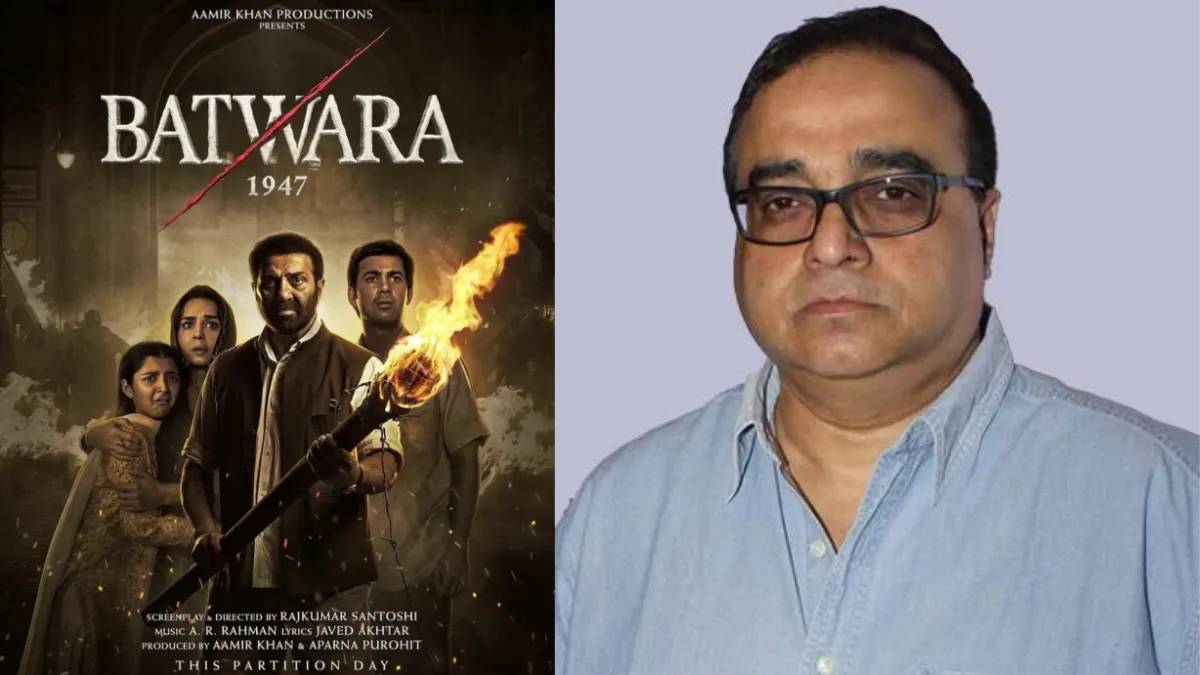
At a recent press conference for Batwara 1947 , earlier titled Lahore 1947, Rajkumar Santoshi spoke about why he chose to make another film on the Partition. The filmmaker said Partition is an event permanently recorded in history. According to him, “Bantwara toh aisi ghatna hai jo history mein darj hai. Bahut saari kahaniyan ban sakti hain. Bahut saari filmein ban sakti hain.” Santoshi compared the subject with major historical events such as the Holocaust and World War II, which have inspired several films and stories. For him, Partition also has the depth to inspire many different stories.
Santoshi Says Partition Has Not Been Explored Enough
The filmmaker also pointed out that Indian cinema has made only a limited number of films around Partition when compared with the scale of the event. Santoshi mentioned films such as Garam Hawa and other works that explored the period. He also referred to the recent appreciation for another film on the subject, saying he had heard a lot of praise for it although he had not watched it himself. Santoshi’s larger point was that Partition has a huge storytelling space. He believes filmmakers can explore different experiences instead of telling the same story repeatedly.
Why Human Relationships Became Central To The Film
Santoshi revealed that what attracted him most was the potential to explore human relationships during the violence of Partition. He spoke about literature he had read on the subject and also remembered his association with Govind Nihalani. Referring to Tamas, he said, “Maine padha hai, iske jaise Bhisham Sahni... Tamas. Govind ji ke saath maine kaam kiya.” He described Tamas as one of the strongest television productions in his view. Santoshi said the film’s treatment of people and emotions stayed with him while thinking about Batwara 1947.
Rajkumar Santoshi Wants To Show People Beyond Religion
The director said the most important part of Batwara 1947 is how it looks at people during a violent period. He explained, “Violence ke beech mein jo emotions hain, wahi cheez ismein mujhe pasand aayi ki insaan ko insaan ki tarah dekhe, na ki Hindu-Muslim ki tarah.” Santoshi also stressed that mistakes happened on both sides during that period. He said, “Hindu-Muslim ki galtiyan dono taraf hui hain.” According to the filmmaker, the Partition era showed both “worst man and the best man.” Some people went beyond expectations and became examples of courage and sacrifice.
Batwara 1947 Is A Film About Human Emotions
Explaining why the story felt important to him, Santoshi said the period was filled with intense passion and extreme situations. At the same time, he found stories of people who showed remarkable bravery and made sacrifices for others. The filmmaker said, “Kuch logon ne out of the way jaakar bahaduri ki misaal qayam ki hai, kurbaniyon ki misaal kaam ki hai.” These human stories are what made the project important for him. Santoshi concluded, “Isliye yeh mujhe bahut important film lagi. Aur yeh film bhi insani rishton ki badi film hi hai.” The film therefore aims to place human relationships at the heart of its Partition narrative.
