



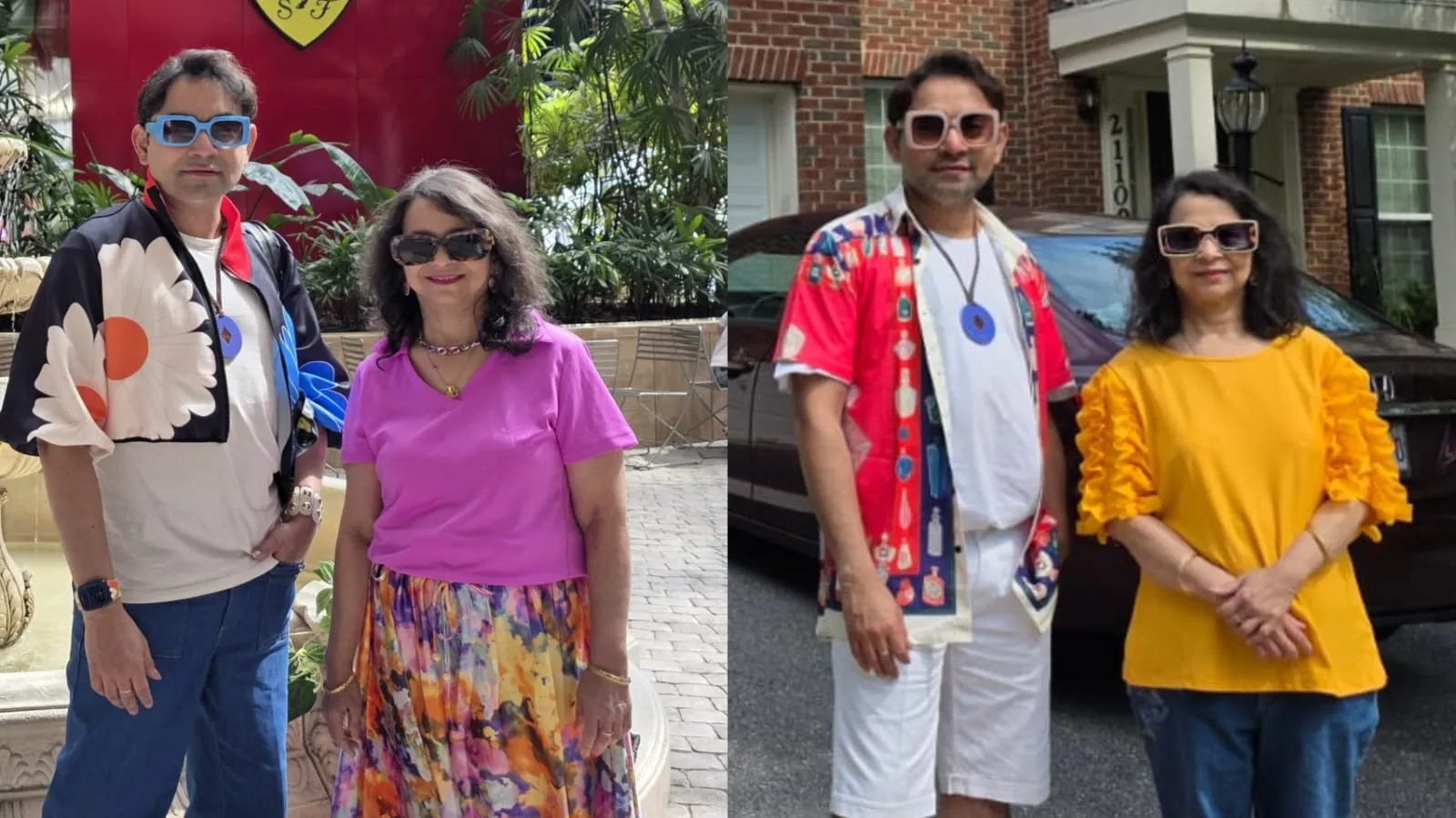
Raksha Bandhan is a festival that celebrates the special bond between brothers and sisters. But for actor Palash Dutta, the festival also brings back memories of a relationship that has remained strong despite nearly three decades of distance. Palash’s elder sister, Parna Dutta, has been living in the USA since 1996. With the siblings separated by thousands of miles, their way of celebrating Raksha Bandhan has changed over the years. However, the bond between them has remained the same.
Talking about his childhood memories of the festival, Palash recalls how his sister would send him Rakhi by courier after moving to the USA. “My last memory of Raksha Bandhan must be from my college days when my sister tied a Rakhi on my hand,” he says.
As the years passed, the siblings stopped exchanging Rakhis in the traditional way. Instead, video calls and messages became their way of staying connected on the occasion. Palash admits that he and his sister were never particularly expressive about their emotions while growing up. They did not constantly tell each other that they loved or missed one another. Yet, there was always an understanding that they would be there for each other.
“We were not that expressive in those days. We didn’t say, ‘Didi, I love you’ or ‘Didi, I miss you.’ But we knew that our parents were there for us, and Didi was always there for me,” he shares
That silent understanding became even more meaningful during difficult times. Palash recalls how his sister supported him financially during the COVID-19 pandemic, when actors and many others in the entertainment industry were left without work.
“She has always been available for me. During COVID, when we actors had no work, my sister helped me financially. My brother and my father also helped me,” he recalls.
The actor has also expressed his affection for his sister through gifts over the years. Knowing that Parna loves gold jewellery, Palash once gifted her an entire gold jewellery set.
“If I talk about the most expensive gift I have given her, it was a full gold jewellery set around 2009 or 2010,” he says.
Even today, whenever he travels to the USA, he makes sure to carry something for his sister, whether it is a saree or something else she likes.
But for Palash, the biggest gift in their relationship has never been something material. It is the strength they continue to give each other. He believes the brother-sister relationship is a sacred one, but also acknowledges that family relationships can sometimes become complicated because of financial disputes, property issues or differences between family members.
Fortunately, he says, his relationship with Parna has never reached that point. “Arguments happen between us too, but never to the extent where one says, ‘Get lost, don’t come to my house,’ or ‘I disown you.’ Our bond gives us strength,” he says.
As both siblings have grown older, Palash feels that their relationship has entered a new phase. He is 54, while his elder sister is 58, and he now wants their bond to be about giving each other strength and ensuring that they are there for one another whenever needed. “I know that whenever she needs me, I will fly there and take care of her. I will give my work a little less priority and be there for her,” he says.
There is a deeply personal reason behind that promise.
Palash recalls the enormous sacrifices his sister made for their parents during their later years. While living in the USA, Parna took care of their mother and father, balancing her job with responsibilities at home. She cooked for them, took them to doctors, managed their medicines and looked after them while also handling her own life.
“She did so much for my mother and father. She worked, cooked, took care of them and took them to the doctor. In the USA, you don’t have maids like you do in India, so she had to manage everything herself,” Palash says.
For him, seeing his sister finally get the opportunity to focus on herself is one of the biggest sources of happiness. Palash says Parna spent years putting her parents and their needs before her own. She did not travel much and often neglected her own well-being while taking care of the family.
“Now I want her to be happy. She made so many sacrifices and didn’t take care of herself. She didn’t travel much either because of my mother and father,” he says.
Today, he is happy to see his sister slowly enjoying life, travelling with friends and giving herself the time and freedom she had put aside for years. “She has started travelling a little here and there with her friends, and she is enjoying now. I like that,” he adds.
For Palash, that is ultimately what Raksha Bandhan means today. It is not simply about tying a Rakhi or exchanging gifts. It is about knowing that there is someone who will stand beside you through every stage of life. His biggest wish for his sister is simple — that she remains happy and takes care of herself.
“My main wish is to see my sister happy. From now onwards, her life should be about taking care of herself and enjoying it,” he says. After years of distance, changing traditions and countless life experiences, the essence of their relationship remains unchanged. The Rakhi may no longer arrive by courier, and the siblings may now celebrate through video calls and messages, but the promise behind the festival continues to remain strong.
For Palash, his sister’s happiness is perhaps the greatest celebration of Raksha Bandhan. “To see my sister happy gives me happiness,” he concludes.
