



Ranveer Allahbadia has found himself in the middle of the Kunal Kamra controversy, but there’s one thing he wants to clear up. A viral post claimed that Ranveer called Kamra a “haathi” and made a comment about his appearance. Ranveer has now denied saying anything about the comedian.
Ranveer Allahbadia Denies Viral ‘Haathi’ Remark
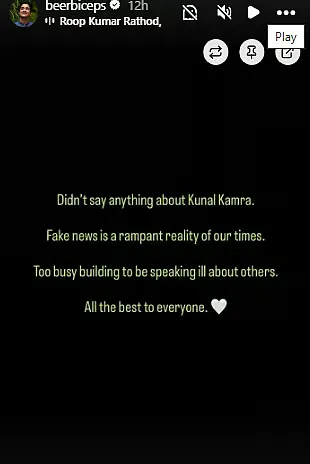
Ranveer, also known as BeerBiceps, addressed the claim on his Instagram Story. He wrote, "Didn't say anything about Kunal Kamra. Fake news is a rampant reality of our times. Too busy building to be speaking ill about others. All the best to everyone."
The statement came after the alleged comment started circulating on social media. The post made it look like Ranveer was responding to Kamra’s recent remarks about the Mahabharat.
However, Ranveer says that wasn’t the case. He has clearly denied making the alleged “haathi” comment about Kamra.
What Did Kunal Kamra Say About Mahabharat?
The whole discussion started with an episode of Gaurav Kapoor’s comedy show Lie Hard. The episode also featured Shubham Gaur, Jaspreet Singh and Sunil Sharma, aka Rofl Gandhi.
At one point, Rofl Gandhi shared a fictional story about helping someone after a road accident. He said the accident happened near Kurukshetra.
That led to a conversation about Kurukshetra and the Mahabharat. Rofl Gandhi said, “When people of UP wanted to fight, they went to Kurukshetra during Mahabharat.”
Gaurav Kapoor then joked about whether he meant the Kurukshetra war or the Battle of Panipat.
Kamra responded, “Don’t mix history and mythology. They are different.” Shubham Gaur replied, “What mythology, man! That’s my history.”
The exchange quickly became a talking point online. Kamra later explained what he meant by the distinction between history and mythology.
He said, “History tells us what we can establish happened.” He also described mythology as a way of understanding what people believed, feared and hoped for.
Kamra later argued that sacred texts can also be understood as cultural beliefs and traditions. He ended his post by saying, “Now you can go back to abusing me.”