


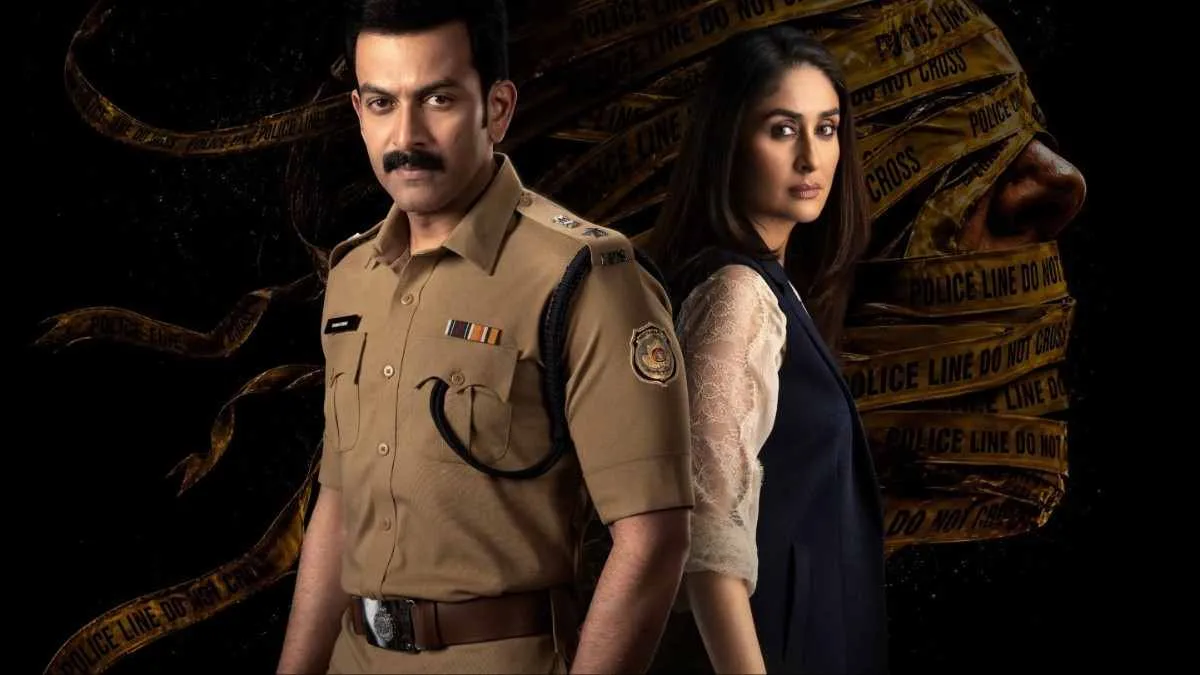
Daayra does not offer an easy answer to the question of whether justice can exist outside the law. Meghna Gulzar instead puts two committed police officers on opposite sides of that debate, with Kareena Kapoor Khan and Prithviraj Sukumaran bringing quiet intensity to a story that grows more disturbing as it unfolds. Read full review to know more!
Daayra Review
Director: Meghna Gulzar
Cast: Kareena Kapoor Khan, Prithviraj Sukumaran, Kshitee Jog, Kanwaljeet Singh, Anuja Sathe
Where to Watch: In Theatres
Runtime: 143 minutes
Star Rating: ★★★/5 stars
Plot Details
Daayra follows DCP Ajooni Kohli, who leads a Special Investigation Team examining a controversial police encounter. The case involves several men accused of gang-raping and killing a young woman before burning her body.
DCP Raman Kumar and his team claim the accused tried to escape custody. Their version becomes the focus of Ajooni's investigation.
The central conflict is clear from the start. Raman believes some criminals leave the system with no choice but to act outside it. Ajooni believes the law cannot be replaced by personal ideas of justice.
The investigation gradually brings those opposing beliefs into focus. Ajooni checks statements, paperwork and evidence. Raman, meanwhile, makes sure his version of events remains difficult to break.
The fictional setting recalls the circumstances surrounding the 2019 Hyderabad rape and murder case, particularly the public debate that followed the accused being killed in a police encounter. Daayra uses that familiar context to examine what happens when people lose faith in the legal system.
Script Analysis
Meghna Gulzar, along with Yash Keswani and Sima Agarwal, keeps the screenplay focused on the investigation and its moral questions.
The first half takes its time. Interrogations, paperwork and procedural details receive space instead of being rushed through. That gives the investigation a grounded quality, but it also makes the opening stretch feel slower than the subject demands.
The non-linear structure helps. Raman's past actions and Ajooni's present investigation move alongside each other, gradually filling in the gaps.
That approach also creates an intriguing tension because the two characters barely cross paths until late in the story. Their opposing methods become the real conversation.
The film is strongest when it refuses to make either side completely comfortable. Raman's anger comes from his frustration with a system he sees as ineffective. Ajooni understands those failures but refuses to abandon the rules because of them.
The screenplay also takes aim at the way crime against women becomes media spectacle. Victims can become headlines, symbols and talking points while the people responsible fade into the background.
Some character threads are less effective. Ajooni's subplot involving her father and his problems with the judiciary does not add enough weight to the central conflict. The personal lives of the two officers also remain underdeveloped.
Still, the film's biggest confrontation is not between two cops. It is between law, revenge and the idea of justice itself.
Performances & Execution
Prithviraj Sukumaran plays Raman with controlled aggression. He does not turn the character into a loud, one-note action hero. Instead, there is a steady conviction behind his actions.
That restraint makes Raman more interesting. He knows what he believes and does not appear troubled by the methods he uses to reach his version of justice.
Kareena Kapoor Khan gets the more internalised role. Ajooni rarely spells out what she feels. Kareena uses her eyes, pauses and controlled expressions to communicate the character's anger and frustration.
Her performance also separates Ajooni from her recent police roles. There is little melodrama here. She is practical, sarcastic and methodical.
Kshitee Jog leaves an impact as the girl's mother. Her grief gives the story an emotional weight that the procedural sections sometimes hold at a distance.
The accused men are also deliberately ordinary in appearance. That makes their behaviour more unsettling rather than less.
What Works & What Doesn't
What Works
The strongest part of Daayra is its refusal to turn a complicated issue into a simple good-versus-bad argument.
The Raman-Ajooni conflict gives the film its backbone. Their approaches are radically different, yet both emerge from an understanding of how broken the system can become.
The film also handles its disturbing subject without constantly relying on dramatic music or emotional manipulation.
Its second half is more assured. As the investigation moves closer to the encounter, the tension rises and the film's central questions become harder to ignore.
The eventual reconstruction of what happened is especially difficult to watch. Gulzar places violence and its consequences side by side without turning the sequence into spectacle.
What Doesn't Work
For all its moral weight, Daayra can feel too restrained at times. The subject calls for greater urgency, but the film often chooses a measured approach instead.
Some supporting characters also feel more like extensions of the main argument than fully developed people. This is particularly noticeable outside the central Raman-Ajooni conflict.
Kareena's controlled performance mostly suits Ajooni, though a few lighter expressions feel slightly out of step with the seriousness of the story.
The result is a film that is thoughtful and unsettling, but not always as emotionally forceful as it could have been.
Technical Aspects
Cinematography plays an important role in creating the film's atmosphere. The flashbacks involving Raman and his team unfold through cramped homes and narrow alleys, often against Diwali lights.
Those sequences have an almost electric quality. They contrast sharply with the quieter investigation led by Ajooni.
Ketan Sodha's synth-heavy background score complements those sections well. The decision to keep Daayra largely free of songs also works. Apart from a B Praak track during the end credits, the film allows its story to dominate.
The editing supports the non-linear structure without making the timeline unnecessarily confusing.
Final Thoughts
Daayra is less interested in delivering a dramatic courtroom-style outburst and more interested in leaving an uncomfortable question behind.
Can a flawed legal system justify taking justice into one's own hands?
The film does not settle that argument. Instead, it allows Raman and Ajooni to stand by their respective beliefs and lets the consequences speak for themselves.
The final confrontation between them is quieter than expected. It may even feel slightly underwhelming after the buildup. But that restraint fits the film's larger point.
There is no clean victory here. Revenge cannot reverse what happened, and a legal process cannot erase the suffering already caused.
Should You Watch It?
Yes, if you enjoy serious police procedurals and films built around moral dilemmas rather than constant twists.
Daayra moves slowly in places, and its first half could have used more urgency. However, its performances, restrained filmmaking and central debate give it enough substance to stay with you after the credits.
It is not a film about finding the perfect answer. It is about understanding why the question remains so difficult.